
All Posts By

admin

A conversation with Battlefield Leadership’s new COO Adrienne Harrison

By Interviews

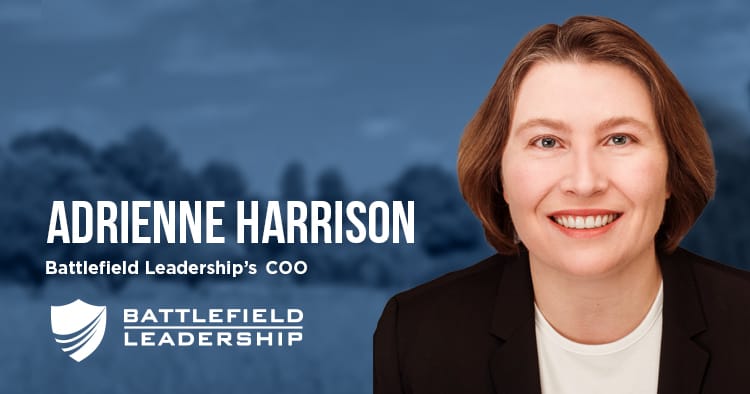
The beginning of a new year often ushers in renewed focus and strategic change for many organizations. Battlefield Leadership is no different. The company recently hired one its highly lauded senior facilitators, Adrienne Harrison, Ph.D. as its new Chief Operating Officer. Her credentials and achievements are nothing short of remarkable.

For more than twenty years, the West Point graduate and decorated Army veteran has led organizations both in and out of uniform. While in the Army, she served as a multifunctional logistics officer in a variety of leadership positions across three combat tours in support of Operation Iraqi Freedom. She played an integral role in the Army’s change management process, transforming the way logistics and life support operations are conducted on the battlefield. She subsequently served as an assistant professor of American history at West Point. After concluding her Army service, she entered the corporate world and held several executive roles before coming to Battlefield Leadership full time as its COO.

 What are you most looking forward to in your new role?

Working alongside our CEO, Kevin Farrell, helping him set the strategy for the company’s operations and growth, ensuring peak performance, and driving results while fostering a culture of continuous improvement across all facets of the organization.

Now that most industries are coming out of COVID, my goal is to expand our client base and focus on how Battlefield Leadership will continue to grow. While I am transitioning from a senior facilitator to COO, I am excited that I still get to use my diverse career in the military and teaching history at West Point to take on content development for our programs.

What do you have your sights set on?

We are putting COVID in the rear-view mirror and 2022 is our year of emergence from it. We are looking at how we can better position Battlefield Leadership than we were before, how many more programs we will facilitate, keeping an eye on year-over-year growth and setting 5–10-year goals.

A lot of your customers can relate to that.

Everyone did what they had to do to get through year two of the pandemic. We at Battlefield Leadership recognize that many organizations aren’t bringing every employee back to the office like it was pre-Covid; this puts more emphasis on making those times when teams do come together really count. Battlefield Leadership is ideally positioned to help leadership teams make the most of those gatherings.

The proliferation of the remote or hybrid workforce creates new leadership challenges in a more dispersed environment. How do you manage a team and hit productivity goals? Virtual meetings enable us to see each other, but it is still a struggle for some. However, when you reflect on history, most leaders did not see their direct reports every day. The lessons of history underscore the need for solid corporate leadership and leadership training to help organizations be stronger in the end, despite the impacts of distance in a more remote work environment.

How has onboarding new Battlefield Leadership team members changed? What recommendations do you have for other organizations?

My plan is to take a more personal approach. One thing we’ve learned in our work with clients is how important it is to ensure that remote workers truly feel like a part of the team. When employees have left, one of the reasons they give is that they felt cut off from everyone and missed that interaction. You must guard against that, and if not, you are going to lose them.

What remains consistent is making sure to clearly communicate what is expected of them and periodically asking them if I have set them up for success. You must build trust between you and your team to let them do their jobs. History is so useful in this regard because it wasn’t too long ago that you trained people and let them do their jobs without hovering because we did not have the same means of communication as we do today.

Why should organizations look at Battlefield Leadership now?

Every business coming out of the pandemic is facing some sort of new normal, whether that means changes to consumer buying patterns, how people communicate, people’s willingness to travel, or some other factor. Whole new industries have been born from being forced to look at and do things differently because of the constraints the pandemic placed on us all.

The common factor is going into the unknown, in a direction you perhaps didn’t anticipate. Where history gives leaders a good measure of comfort is when you play the tape to the end, you can assess the second and third order consequences on decisions. Leadership lessons don’t change, circumstances do. They realize that they are not alone – they see the same types of challenges, emotions and conflicting arguments have all been played out. Being able to understand that and play in context builds strength.

For those who may be leading in ambiguity and are uncertain of what lies ahead, it is the perfect time to reach out to Battlefield Leadership. We are excited to get back to work to help organizations successfully navigate challenging times ahead.

Through our unique programs, leaders from Fortune 500 companies, government entities and higher education institutions learn how to overcome these challenges and transform their organizations, positioning them for future successes. Find out how Battlefield Leadership can help yours by emailing info@battlefieldleadership.com or by calling 864.386.9637.  

Three ways your leadership team can fail (and what to do about it).

By Field Experience

At Battlefield Leadership, we believe that three core tenets of strong leadership are character, courage and competence. In our executive leadership programs, we use history to help today’s leaders experience the weight, impact and consequences of the decisions historical figures made in shaping our country’s past to help strengthen their leadership skills for their future. The best leaders who fully embrace and master these tenets were, and continue to be, put to the test with the disruptive impact to work and our lives that the pandemic caused.

What leadership challenges do our Battlefield Leadership facilitators consistently see, especially considering unforeseen issues and opportunities brought forth by the pandemic? How can history teach today’s executives leadership lessons to help overcome them?

Here are three:

1. Communication from the Top

When everyone suddenly began working through virtual platforms full time, many organizations struggled to adapt to being scattered and physically detached from their teams and customers. In a virtual or even hybrid setting, it is even more important to ensure that your team maintains focus on their organization’s goals. Having clear communication from the top is imperative for success. Did the leader’s intent and vision cascade throughout the organization or is there confusion? Was the message sent the message that was received?

2. Organizational Culture

Leaders create their organization’s culture which produces behaviors within their teams that create results. When organizations are upended, whether by events out of their control or ones that bubble up internally, the cracks in the armor are amplified. Are leaders living up to the organizational values and are they taking ownership to drive desired behaviors?

3. Leadership and Organizational Agility

The pandemic put a spotlight on leadership deficiencies. Being able to align your team and pivot quickly when opportunities arise is a differentiating factor between those who thrive versus those who just survive or even damage their brand. Just because an opportunity lands on your doorstep doesn’t mean leaders and organizations are able to capitalize on them.

Through our unique programs, leaders from Fortune 500 companies, government entities and higher education institutions learn how to overcome these challenges and transform their organizations, positioning them for future successes. Find out how Battlefield Leadership can help yours by emailing info@battlefieldleadership.com or by calling 864.386.9637.
How Historical Leadership Lessons Transform Today’s Organizations.

By Field Experience

We recently sat down with two of our senior facilitators, Adrienne Harrison, Ph.D, and Jim Czupil. We wanted to learn why organizations participate in Battlefield Leadership Experiences and how these programs create a unique competitive advantage with stronger teams geared toward long-term success.

What surprises participants most about what they can learn from history, and in particular, military history?

AH: They are surprised at how relatable historical figures are to what they are dealing with. At first, they think the pressures we face aren’t the same, especially with our 24/7 plugged in work world. Leadership, and the pressures and decisions that leaders make are timeless. The rest of it is circumstance. We frame history so people can relate to in their everyday life. For example, both have a window of opportunity to make decisions, both analyze cost/benefits of a decision. They realize they aren’t so different after all.

The benefit is hindsight. They see how decisions have second and third order effects that play out and the history gives them a vehicle to analyze their own decisions and validates their gut feelings or choices made that impact their lives today. They realize they can learn from this, and suddenly, it makes sense.

JC: What also surprises them is not only how it impacts them as leaders, but how it affects their organizations. We talk about the difference between deliberate and emergent strategies and how historical leaders behaved when opportunities were presented. We use the pandemic as a great example. Most organizations had an operational plan prior to March 2020, but when the pandemic hit, suddenly, all these emergent strategies came out because of other opportunities and possible challenges. We take them right from what historical figures were doing to how it affects their business.

For some, the connection of military history to their business is a leap, but we end up winning everyone over. That is a tribute to the way our historians work with our business analysts and our clients.

Jim, from your side of things, what surprised you most about the application of military leadership to corporate America?

JC: I was introduced to Battlefield Leadership while in corporate America where I was responsible for executive education for The Hershey Company. The “aha” moment came for me when we had Battlefield Leadership facilitators talk with executives about military leadership perspectives. I realized there was a direct application to what we were dealing with and there was a huge opportunity to connect these two. The advantage of me coming from the corporate side is I have been in countless talent and succession planning meetings. The corollary between the kinds of things that derail some business leaders or make others move forward are the same in the military.

Have you ever had an engagement where the leader realized they didn’t have the right talent at the table?

AH: Actually, quite the opposite. We had a leader who conducted a personal assessment of a team that was perceived as possessive and resistant to change. They engaged Battlefield Leadership to validate whether their assessment was correct. From what we observed in how they engaged with the historical decisions, this leader realized the need to further invest in this team with targeted development to settle these individuals into their roles because they would not have been successful without it.

JC: We also do a lot of executive coaching outside of the experiential programs, and we have developed relationships with participants to help them beyond the program.

Are there differences between military and non-military organizational leadership?

AH: The most obvious is that in the military, leaders give orders that are obeyed. Military leaders are trained to be comfortable making decisions and holding the people underneath them accountable.

The similarities are that organizations need to have depth and leaders need to be developed. In the military, there is so much emphasis on education and leadership training. You may hire leaders for your organization who have gone through leadership training, but that’s not the norm.

The sense of purpose that the military brings is what corporate leaders gravitate to the most. At Battlefield Leadership, we bring the best of the military example over and make leaders comfortable with their authority and responsibility for the people they lead whose livelihood is in their hands.

Why should leaders choose Battlefield Leadership from other executive leadership programs?

JC: What separates us is the way we make it relevant to their company and to them as individuals. We bring the best military, history and business experts together to tie our clients’ specific business challenges to military history.

AH: We build the bridge from history to timeless leadership challenges and make it relevant in a way that you don’t get with other leadership development programs or a business book. That’s the beauty of hindsight.

To inquire about engaging Battlefield Leadership for your organization’s leadership development email info@battlefieldleadership.com or call 864.386.9637.